How to Draw With Paint Net
Writer's Block Weekend
This week nosotros've been looking at pixel art and by at present yous might be wanting to give it a try.
But how do you get started?
I'grand not talking fine art theory here, I mean how to literally beginning cartoon pixel art. Well equally the proper name might suggest, pixel art is primarily a digital medium, and then y'all're going to demand some sort of art program to draw in. Now there's a lot of art programs out there, heck you probably already take some. Most of these tin do pixel art, but today we're going to be looking at a free program called Pigment.Net
Before I go whatsoever farther I'd similar to point this out right now: Paint.NET is NOT the same as MS Paint. MS Pigment is that drawing program your windows computer came with. You can practise pixel art in MS paint, only I wouldn't suggest it… Trust me, unless you want to attempt pixel art-ing in hard way it really isn't worth it. That'southward not to say you can't, but I actually can't recommend information technology. Not when at that place is a much improve complimentary culling available to yous. You can get it hither: world wide web.getpaint.net/alphabetize.html
(You might as well, information technology's a really good free art program. What's not to similar?  )
)
Setting upwardly Paint.NET for pixel art
And so you've installed Paint.NET, opened information technology up, and you lot see this:

Some of the things hither volition probably look pretty familiar; a tools section, colour section, history and layers tabs, etc. Hopefully y'all won't experience too lost, and we shall go into more detailconcerningsome of these areas in a bit, merely offset let's look at the sail.The sheet is the area of the screen y'all volition exist working on, the big white space in the middle. Now the canvass isn't really white. You'll detect that to the side is a layer called "Background". Unchecking the layer will turn off its visibility and once you lot practice this y'all should see a grey and white checkerboard. In reality the canvass is transparent and when we describe we modify the pixel in that spot from being transparent to non transparent, merely more on that later.
So are we gear up to start? Well, yes and no. When we do pixel art we volition be drawing at the pixel level; essentially our art is very very minor. Currently our canvass is 800 ten 600 pixels in size. For most digital drawing this is fine, only for pixel art this sheet is ginormous! And so let's scale information technology down a bit.
To modify the size of the canvas y'all'll want to select Image and and so Canvas Size, or utilize the shortcut CTRL+SHIFT+R.

A window will have appeared that looks like this:

For pixel art the merely areas we really intendance well-nigh are the ones I've highlighted beneath; Pixel Size,Width & Meridian, and Ballast.

Y'all'll notice that the Width is currently gear up to 800 pixels and the Height is 600 pixels. To change the canvass size simply put in new numbers. For me I like to start with a l x l sheet, which is as well the aforementioned size as DeviantArt icons. So let's make a fifty ten fifty canvas.

That's better, but let'south say yous determine you actually want a canvass that'southward 100 pixels tall. No worries, simply open up the Canvas Size window again and alter the value in Acme to 100.
Now I said earlier that the other area that was of import to united states was Anchor. When yous change your canvas' size the new area will be added in relation to what y'all've prepare your anchor as. And so if your anchor is gear up to top left (the default) the new parts of your canvas will be generated to the right and below what you lot already have. This becomes important once you've started drawing and want to change the size of your canvas. To change your ballast select from the drop down list or only tap the square of your choice. If you want the new area to be added equally all around what you already have utilize Heart, if you want it in a higher place use Acme, beneath apply Bottom and so on. The arrows will show yous where the new areas of sail will appear.

At present yous might have noticed there's another choice called Resize and wondering why we didn't use that. Resize is what you use when you want to scale your image up or make it smaller, kinda similar zooming in and out in a more permanent way. We'll wait at how to use this later, but for now retrieve: if yous want to change the size of your sheet use the Canvas Size option.
You have now successfully made a sheet and know how to change its size, but every bit we work in a pixel level yous're going to want to zoom in a lot. In the bottom correct corner are the zoom controls. Remember to view your piece at its bodily size every now and again though.
Okay at present nosotros tin can kickoff making things!
...well virtually.
Aliasing vs Anti-aliasing: What you need to know
Before nosotros proceed nosotros need to talk nearAliasing,Anti-aliasing, and what they mean for pixel artists. Yes I know, y'all want to get to exciting parts, but this is really important, considering understanding this is going to aid explain why we will make sure choices going frontwards.
In the world of digital art everything you come across is a pixel lit up on the screen. That'southward the raw truth of it. Your art is stored equally 1s and 0s and they tell the graphics card in your figurer what colour to make each pixel. The pixels on your screen are set out in a grid format, which is great for things that have straight edges and xc caste angles, but terrible for anything curved. The outcome is a something called Aliasing, and information technology gives curves a zig-zaggy, jagged appearance. To fix this a bunch of really smart graphics coders came up with Anti-aliasing to remove the advent of jaggy edges by blending the colours of the surrounding pixels together. This creates a gradient like effect and so that when zoomed out everything looks nice and smoothen. The colour a pixel will end up having is adamant by an algorithm and out of the artist'southward easily.

This is great for everything but pixel art. As pixel artists we want to work at the pixel level, determining what each pixel will be as we go, but nosotros're kinda in the minority on that one. Nosotros actually preferAliasing. When Anti-aliasing is involved we lose the ability to take consummate control over our medium. Unfortunately for united states almost art programs will accept Anti-aliasing defaults enabled, and Paint.NET is no exception.
Fortunately this is really piece of cake to gear up. When y'all open Pain.Internet your default tool is the paint brush and you volition encounter this bar above the sheet:

Currently Anti-aliasing is enabled so you'll want to disable information technology by clicking the push button that looks like a curved line with dots through it. Information technology is as well advisable to modify the Due southelection clipping mode (currently a circle with dots through it) to Pixelated pick quality. Your bar should at present look like this:
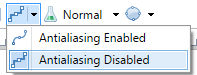

These settings will stay this way beyond all the tools. Having it ready like this is going to requite you complete control over your pixel art, stopping things like colour bleeding and soft erasing from happening. Feel free to play around with these settings at your leisure though. Experimenting is a dandy way to acquire, plus digital art has Undo
Tools of the trade
And then now we've set for optimum pixel art-ing let'south await at the tools we'll use.

First and foremost is the Pencil tool (shortcut: P)
This is your main tool and it simply does one matter; brand marks 1 pixel broad. That'due south it and it is great!
And no, you tin can't make it whatsoever bigger than 1 pixel. (That'south the Paintbrush which we'll expect at later).
The Pencil tool is used for everything from making rough sketches to item work. I notice I use this tool the most out of any hence why information technology'southward existence mentioned offset.

Next is the Line/Curve tool (shortcut: O)
While the Pencil tool is great information technology tin can get a chip fiddly when y'all want to draw long lines or, perchance more than chiefly curved lines. In these situations yous'll want to use the Line/Curve tool. This tool has a bit more than to it though, so let's suspension it down.

Curve types: Spline vs Bezier


Spline has control points that the line has to run through while Bezier let yous drag them across the screen as the line is pulled towards them. Either is fine and both work past you grabbing a bespeak and moving it. I similar Spline personally and information technology's the default, but utilise what works for you.
Next: brush size
It's pretty simple, the bigger the brush size the thicker the line will be. Following that are fashion and fill, which don't really work at the pixel level anyhow and so you tin merely leave them as their defaults.
Final things to know almost the Line/Curve tool:
In one case yous draw a line it will be in its "edit" mode and while like this you lot can change it and edit it as much every bit you like. You can fifty-fifty move information technology beyond the sail. Once you're happy with it hit ENTER to "finish" your line. Drawing a new line or changing tool volition too "stop" your line. If you weren't done editing it, only hitting Undo and you should be dorsum in the "edit" mode.

Following this is the Shapes tool (shortcut: O)
Yep, the short cut is the same as the Line/Curve tool, but in all fairness these tools are very similar, and pressing "O" multiple times volition toggle between them.
This tool allows you lot to draw shapes which is swell. So if you want to depict a circle, rectangle, triangle, etc this is what yous desire.
Breaking this tool down; first nosotros take the shape type, which you employ to pick your preferred shape.
This is followed by draw type, which lets you choice between drawing the shape outline, the filled shape or the filled shape with outline. The rest is the same equally the Line/Bend tool, including the fact that the shape will go into an "edit" manner once you've drawn information technology. Same methods as before to finish information technology.

Next is the Pigment Saucepan (shortcut: F)
You might know it every bit the "Make full" tool.This tool is great for colouring large areas quickly. The defaults on this i are basically alright for y'all to utilise straight abroad.
However there are two things to beware of:
Commencement make sure the Tolerance is way downward; I find having information technology round 15% or lower is expert. If yous don't do this the Pigment Saucepan will often think colours next to the surface area you lot're trying to colour are essentially the same, and fill them also. Significant that you can colour the wrong areas by blow.
The other matter is that the Paint Saucepan has an "edit" mode also, and if you lot selection a unlike colour while even so in this style the expanse you just filled will change color to match the new one you picked, so be careful. If either of these things happen a elementary Undo should fix it.

Speaking of colour our adjacent tool is the Colour Picker (shortcut: Thou)
Again, this is a pretty standard tool which allows you lot to select a colour from a specific betoken on an paradigm. This is smashing if yous're working with colour palettes or want to speedily change between colours that are already present on your image.
This tool is pretty much expert to get.
The but thing to note is that by default the sampling is prepare to Layer, pregnant it volition only select colours from the layer yous're on. If the colour you want is on a unlike layer you can swap to that layer, pick the colour, and so swap back to the layer you lot're working on. Alternatively you lot tin can change the sampling to Image which will allow y'all to pick whatever colour currently on your canvas, regardless of layer (Useful if you have your color palette on its own layer).

Next nosotros take the Eraser (shortcut: East)
You can utilise this straight abroad. Changing the size will brand your eraser bigger or smaller and that's pretty much it. Exercise note, when you erase a pixel you are removing all colour from information technology, making that pixel transparent.

Finally I want to talk nigh the Selection and Move tools (shortcut: S and M respectively)
Y'all can use these tools when you want to motion things around the canvass, or change their size or shape. Using the Choice tool, you can select an area on your canvass. Once an area is selected, changes will but occur within that infinite; so if you were to describe a random squiggle it wouldn't go exterior the selected area. When y'all're finished striking CTRL + D to deselect information technology. If you weren't finished with it and it somehow deselected itself (and this tin can happen from fourth dimension to time) Undo should fix it.
Adjacent are the Motility tools. You'll mainly want to use the Movement Selected Pixels tool (or the blue arrow i) equally this ane will allow you to actually move things beyond the sail. If y'all use the Move tool without an surface area already selected, it will automatically select the whole layer.
Practice note, if you desire to use the Motion tool to alter the shape, size or rotation of your selected area, brand sure you set the quality to Nearest Neighbour not Bilinear, as Bilinear uses Anti-aliasing and we know how annoying that is for pixel art.

And as promised here's the Paintbrush (shortcut: B)
To be honest I don't employ this tool too much which is why it's here, simply it'south pretty easy to use regardless. The only thing you really demand to know is that changing the brush size volition brand the Paintbrush larger or smaller.
Handy Tips & Tricks
That wraps upward tools, now let's talk nearly some tricks to make your pixel art experience easier.
 First, utilise Layers . Layers are really great and allow yous to separate parts of your work, thus making things easier to manage. For example, yous might have the colour palette on i Layer , your base sketch on another, the apartment colours in a higher place information technology, and so on. I would recommend against doing all your work on the aforementioned Layer every bit things can go confusing rather quickly. Besides, naming your Layers can be a adept habit to get into every bit well. I also suggest starting your piece of work on a new Layer and changing the background to a different color; something other than white or black, or simply one that doesn't feature besides much in your slice. You can proceed this Layer'southward visibility off most of the time, but having it will assist you ensure that you don't have whatever unpainted pixels floating most when you're prepare to finish.
Side by side, if you lot find the colour , tools , history or layers tabs are getting in the way, you can elevate them to dissimilar spots or turn them on and off using these buttons:

You also accept a Pixel filigree which y'all can turn on. Information technology will prove up when you zoom in, and tin can exist useful for counting pixels or just equally a general guide.

Remember Resize ? You can use it to resize your pixel art from being tiny to something big then everyone can meet the piffling details. Merely make sure to set up Resampling to Nearest Neighbour , or things volition get fuzzy…literally.
Brand sure you lot relieve your work equally often as possible!
Wrapping upward
And then you've created some pixel art, it looks cracking, and now you desire to submit it to DeviantArt. Before you do that you'll want to make sure information technology'south saved in an image format. By default Paint.NET saves files with multiple layers equally a .internet file, and then it can keep all the Layer goodness. However now that you've finished information technology's fourth dimension to relieve your work equally something similar a .png (which I recommend over .jpeg as information technology volition keep the transparent areas transparent). To practise this go to Save Every bit , change the file type to .png and hit Salvage . After doing so a window called Fashion Configurator volition appear. You can leave things to their default and merely hitting OK. It will and then tell y'all that information technology has to flatten all your Layers , just this is fine, and assuming you accept been saving your work as a .net file as you went you lot won't lose any of those Layers , they'll just exist in a different file.
And that'due south pretty much information technology.
You at present accept a ameliorate understanding of Pigment.NET and you're set up to go make some awesome pixel art!

Cheers for reading, at present go have fun! 


Source: https://www.deviantart.com/trixynetex/journal/How-to-Make-Pixel-Art-in-Paint-NET-618218367
0 Response to "How to Draw With Paint Net"
Post a Comment